What this is: 14 real entryway organization ideas for renters, built around why stuff actually piles up by the door instead of just where to put a basket.
Who it’s for: You, if your keys, mail, and shoes have created a genuine ecosystem on the floor by your front door and you’ve stopped noticing it.
Why read it: Most entryway advice tells you to buy a bench and some hooks. That’s not wrong, its just incomplete, and I want to actually fix the problem instead of decorating around it.
I used to think my entryway chaos was a discipline problem. Like, if I just tried harder, I’d put my keys in the bowl instead of on the counter three feet away.
Turns out that’s mostly wrong. Entryway organization that actually works isn’t about willpower, its about designing a system that matches what you actually do the second you walk in the door, hands full, brain already somewhere else.
Fourteen ideas here, and I’m gonna be honest with you about which ones matter more than others.
Add a Bench Only If You’ll Actually Sit There
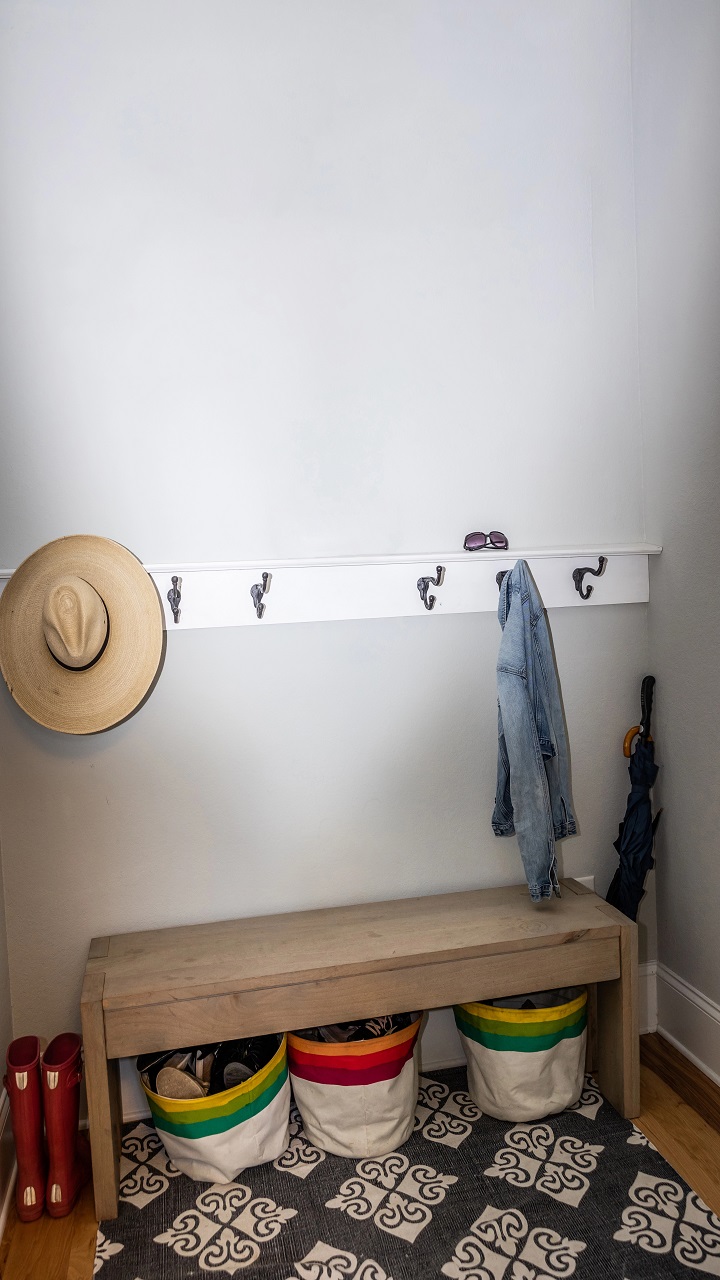
Benches are the default entryway furniture recommendation, and they’re genuinely useful — for some people.
If you actually sit to put on shoes, a bench earns its floor space. If you don’t, it just becomes another flat surface that collects clutter instead of solving it.
Be honest about your actual habits before you commit real square footage to a piece of furniture.
Mount Hooks at the Height You Actually Use
A hook mounted too high or too low gets skipped, no matter how good it looks in a photo.
Test the height with your actual coat, actual bag, actual routine — not a showroom mockup.
Use adhesive hooks rated for the weight of what you’re hanging, and if you’re a household of more than one person, put multiple hooks at multiple heights instead of forcing everyone to use the same spot.
Put the Drop Zone Exactly Where Your Hands Are Full
Location matters more than product here, and this is where most renters get it wrong.
A professional organizer explains the actual mechanism: when you come through the door with your hands full, you want to unload immediately.
If there’s a spot right there, you’ll use it; if it’s three steps further into the apartment, you won’t.
This is why a beautifully organized closet down the hall gets ignored while stuff piles up at the door. Distance is the whole game.
Use a Basket Instead of a System You’ll Never Maintain
Sometimes the fanciest-looking solution is the one you’ll actually abandon within a month.
One renter documented switching from an elaborate multi-bin system to a single basket by her door, and the simplicity is what made it stick.
She started automatically placing items in it without thinking, and her entryway stayed noticeably tidier as a result.
If your system requires decisions every time you use it, you won’t use it consistently. One basket, zero decisions, is often the better system.
Don’t Limit Yourself to One Drop Zone
This one genuinely changed how I think about the whole problem.
A drop zone doesn’t have to live exclusively by the front door — you can have multiple drop zones throughout your home, like keys and bags at the entrance and a separate spot for mail closer to where you actually sort it.
If your entryway is small (and in a rental, it usually is), splitting the load across two smaller zones can work better than cramming everything into one.
Start With What Actually Gets Dropped, Not What Looks Nice
Most entryway advice starts with the furniture. That’s backwards.
Organizers who specialize in this exact problem point out that a bench and a row of hooks is usually treated as “good enough,” when really it’s incomplete. The actual design question is what specifically comes through your door on a normal day, and how much of it.
Before you buy a single organizer, spend a week just noticing what lands on the floor. That list is your real design brief, not a Pinterest board.
Give Mail Its Own Dedicated Spot Immediately
Mail is the single most common thing that creates entryway chaos, and it’s also the easiest to fix.
A dedicated tray or slot for mail, placed right where you first touch it, stops the slow spread across every flat surface in your apartment before it starts.
Sort it weekly if you have to, but give it one contained spot in the meantime instead of letting it migrate.
Use a Tray for Keys, Not a Random Bowl
This sounds like a small distinction and it kind of is, but it matters more than you’d think.
A shallow tray with actual dividers or sections keeps keys from sliding around and getting buried under everything else you toss in. A generic bowl becomes a junk catch-all fast; a tray with intention stays a keys-and-essentials spot specifically.
Give Every Single Item One Home, No Exceptions
This is the single most useful rule I know for entryway organization ideas, and it’s not complicated at all.
Every item that regularly comes through your door needs exactly one designated spot located close to the entrance, so putting it away is faster and easier than dropping it on the floor.
Mail gets one tray.
Keys get one hook. If an item doesn’t have a home yet, that’s exactly the item that’s ending up on your counter right now.
Solve Shoes With a Closed Container, Not an Open Pile
An open shoe pile by the door is one of the fastest ways an entryway starts to feel chaotic, even when everything else is under control.
A closed bin, a slim shoe rack with a front panel, or even a lidded basket keeps shoes contained instead of visually spreading across the floor.
It’s the same square footage either way — contained just reads as organized, and open just reads as clutter.
Keep the Drop Zone Small Enough to Empty in One Trip
This is a genuinely underrated design constraint, and it’s the reason a lot of entryway systems quietly fail.
If your drop zone can hold two weeks of accumulated stuff before it looks obviously overflowing, you’ll let it get there.
Size it so it visibly fills up fast — that discomfort is what actually prompts you to empty it regularly instead of letting it become a permanent landfill by your door.
Make It Renter-Friendly From the Start
Every piece of this system should be something you can take with you, not something built into the apartment.
Freestanding baskets, adhesive hooks rated for weight, a small table instead of built-in shelving — none of it requires your landlord’s permission, and all of it moves with you to the next place. There’s no reason a functional drop zone has to mean drilling into anything.
Review What’s Not Working Every Few Weeks
Most people set up an entryway system once and never touch it again, even when it’s clearly not working.
If keys are still ending up on the counter instead of the tray, that’s not a you problem — it’s a location problem, and it’s worth actually moving the tray rather than trying harder to use the wrong spot.
Give any new system a few weeks, then be honest about what’s actually being used and what’s being ignored.
Accept That “Perfect” Isn’t the Goal, Consistent Is
Here’s the thing that actually matters more than any individual product on this list.
A slightly imperfect system you use every single day beats a beautiful one you abandon after two weeks. The goal was never a Pinterest-worthy entryway — it was reducing the daily friction of walking in the door with your hands full.
Judge every idea on this list by that standard, not by how it photographs.
Your Entryway, Actually Working Now
Here’s the real takeaway: the chaos by your door was never really about the door. It was about designing for what actually happens there instead of what looks good in a photo.
Give every item one home, put it exactly where your hands are already full, and keep the whole system small enough that you’ll actually maintain it.
Do that and this is genuinely the last time you’ll have to think about your entryway at all.
